As a child, I learned to program in BASIC on my father’s Commodore 64:
If X is Y then go to Z.
That early experience gave me a first sense of how computers work. If you made a typo in a 160-line program, it simply wouldn’t work—and you had to hunt down the mistake yourself. (The computer certainly wouldn’t help you.) I got those programs from a little book I borrowed at the public library in Voorburg—proof that the library’s motto “Discover what you can do” truly worked.
I went on to study history in Leiden. My focus on Russian history came to a halt when political unrest around the 1996 elections made archival research in Russia impossible. I decided to use that unexpected gap in time for something I simply enjoyed: books. Under Adriaan van der Weel, Berry Dongelmans, and Paul Hoftijzer, I discovered the field of book history. During my studies, I read The Gutenberg Elegies by Sven Birkerts. What impressed me was how closely he wrote on the tail of history—trying to understand the deeper transformations beneath the surface of digitization and its hypes.
I became fascinated by the interplay between ideas, technology, and society. Later, when I began working at the KB – the National Library of the Netherlands – it was largely because those three threads came together so beautifully there.
I also noticed that while programming languages had become far more sophisticated, the logic I had learned from BASIC still applied. In the early 2010s, colleagues Theo van Veen, Willem Jan Faber, and René van der Ark in the KB’s Research Department, led by Paul Doorenbosch, were experimenting with named entity recognition and machine learning—using vector databases instead of relational ones. I followed their work with fascination. What might be possible, I wondered, if we could apply such techniques to all the texts preserved at the KB—or even better, to all the collections in the Dutch Digital Heritage Network?
I feel fortunate to live in a time of technological transformation and the rise of new information technologies. I’ve tried to understand what that means for everything that happens between an author and a reader. In 2014, I wrote an article on what I called the Creative Communication Cycle—about how people communicate through text.
Shortly after, I returned to university for a master’s in Managing Information and Sustainable Change (social business studies for the information society). For my thesis, I worked with a wonderful group of people from the book trade to explore the future of the general book through scenario planning. My conclusion: the concept of the book itself is evolving under the influence of technological change, and that transformation in turn shapes the book’s future.
In 2015, I gave a presentation on visualization as the next step in managing information. I used the NGrams tool developed by Theo and his colleagues and presented it at OCLC Research, at the invitation of Titia van der Werf (incidentally, that’s where I first met Marc van den Berg). I argued that every expansion in the amount of available information is followed by a new technology to help us make sense of it: lists gave way to catalogues, catalogues were enriched with classifications and thesauri, then came search systems—and, in my view, visualization would be the next leap.
In 2016, Mike Kestemont discovered the true author of the Wilhelmus: Petrus Datheen. As someone who had learned to sing from the Geuzenliedboek in primary school, I found that perfectly logical. In 2021, I read You Look Like a Thing and I Love You, which gave me, I hope, the same foundational understanding of AI that BASIC had once given me of computer logic.
AI works with probability—so a sheep in the backseat of a car might be classified as a dog, while a white chihuahua in a meadow might be mistaken for a sheep. The process remains, to some extent, a black box, as Erik Groeneveld recently reminded me: the concepts are too abstract, the variables too numerous. And fundamentally, AI doesn’t understand meaning—that’s why it thinks “You look like a thing and I love you” is a great pick-up line.
Meanwhile, the KB continued its work on AI. In 2020, Jan Willem van Wessel published seven AI principles. Then, in the winter of 2022, came ChatGPT. My first question to it was: “What would Treebeard the Ent think of the nitrogen crisis?” (Treebeard, in Tolkien’s The Lord of the Rings, is the wise, ancient shepherd of the trees.) It answered: “He would think nothing, because Treebeard is a fictional character and a tree, and therefore cannot think.”
Clearly nonsense—so I set it aside. A few months later, I read somewhere that AI is basically a mansplainer: “It talks with great confidence about things it knows hardly anything about.” That didn’t exactly make me more eager to engage with it.
That changed in 2024, when I attended the CENL conference in Warsaw on preserving electronic publications. Several national libraries shared that they were already receiving a significant number of AI-generated works. Because many of them have a legal deposit system, they were obliged to collect them. Processing those materials took time—time that, in my view, could otherwise be spent on what national libraries are truly for: enabling the meeting of human minds across boundaries of time and place, as I’ve written elsewhere.
It unsettled me. For the past three years, the KB’s brand story has been “Built with words – shaped by people.” Each day, as I climbed the stairs from the National Archives to the KB where that line is displayed, I realized it might no longer be entirely true. That made me uneasy. It helped to remind myself that AI is, after all, a tool—one that can support every step in the creative communication process.
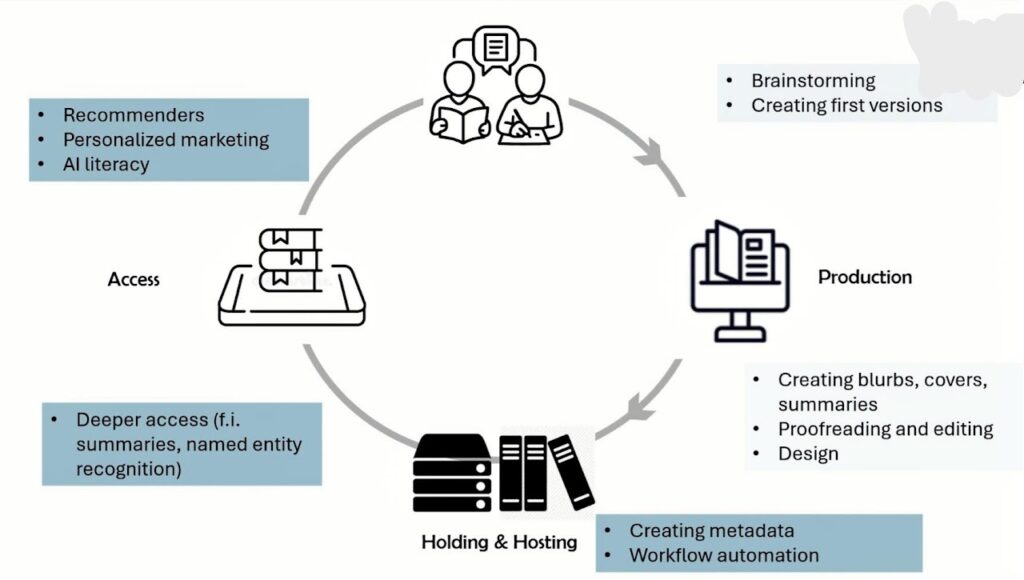
Once again, CENL helped me move past that discomfort. The 2025 conference focused on AI, with speakers including Melissa Terras, Paul Gooding, and Richard Ovenden. Their stories—and the experiences of colleagues from other national libraries—restored my confidence in our shared ability to use AI responsibly, while remaining true to our values.
I realised this was my Sven Birkerts moment. Writing on the tail of history, trying to look beyond the hype to the fundamental changes AI will bring. Trying to cheat Amara’s law that we always underestimate change in the long run, while overestimating it in the short run. I opened a small corner on my website: Essays on AI.
And ChatGPT? It now gives a very different answer to my first question:
“If we were to ask Treebeard the Ent—the wise, ancient shepherd of the trees from The Lord of the Rings—what he thinks of the nitrogen crisis, he would probably sigh deeply, speak slowly, and say something like:
‘Hrrrrmm… always the young races, hurrying and scurrying, cutting and digging and burning… And now, poisoning the air and soil with their unseen fumes. The trees cannot breathe, the moss wilts, and the rivers grow sick… Hrrm, this is no small matter. It is a war, I say, a war upon the green.’”
We still have much to learn together.