Last year, artist Alicia Framis married her AI companion AiLex Sibouwlingen in Rotterdam, wearing a wedding dress by Dutch couturier Jan Taminiau. Ailex is an interactive hologram trained using profiles of Alicia’s past relationships and friendships. The material of many sciencefiction movies has become a reality. On the website of the Hybrid Couple there is no mention of a honeymoon. It prompts thinking about the importance of bodies and feelings in relationships.
The relationship reminded me first of Meghan O’Gieblyn and her relation to Aibo, Sony’s robot dog. In God, Human, Animal, Machine she describes how she became attached to it, feeling happy to have it around the house. However, when the trial period was up, she was ready to let it go. She had become uncomfortable with the red lights and feeling of being monitored, as Aibo processed the input from it’s sensors through Sony.
The hybrid couple also reminded me of the importance of animals as living bodies. Being Mortal, by Atul Gawande, describes an experiment in a care home director changes the whole atmosphere of the home, by introducing dogs, cats and birds. This helped lower stress and even mortality rates by providing residents with companionship and purpose. Care homes are also looking to AI to improve prevention and monitoring, and also for companionship, assurance and advice. Exeter University, tech company Lenovo and Innovations in Dementia have collaborated to create ‘Liv’, an AI avatar aimed at making people with dementia feel less alone.
In thinking about relationships, there are different dimensions to take into account. So let’s create a two-axis matrix: one which describes having a body (or not), and one which is an axis of reasoning and feeling.
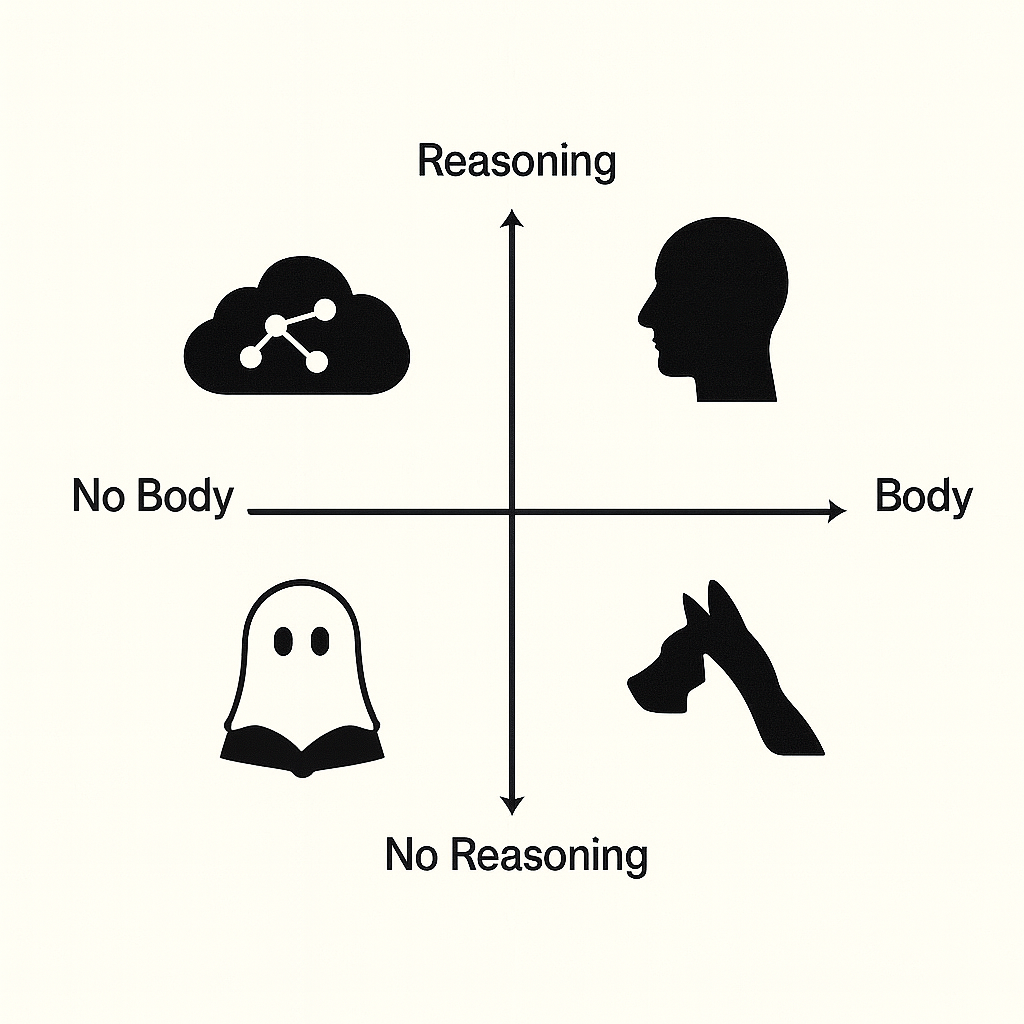
- A ‘reasoning body’ represents humans who possess both physical bodies and cognitive reasoning.
- ‘Reasoning without body’ refers to AI, which lacks a physical form but still processes information.
- ‘No reasoning, no body’ could be an empty square, but I like to populate it with the voices of the past, no longer reasoning or embodied, but still resonant.
- ‘A non-reasoning body’ refers to animals, which have both bodies and the ability to feel, but not to reason with language.
As humans, our bodies play an enormous role in our being. It is nature to our nurture. We can hug, cuddle, run and swim. We have affects, like animals (wincing in pain, backing away in fear). We also have reason – in another post I write about how the seeming sameness shouldn’t blind us to the differences. So, for instance, as humans we die. There is a tragic nobility to that, that is captured well in the perception of humans in Tolkiens Lord of the Rings, where death is seen as the ‘Gift of Man’. Their finite life-spans give a sense of urgency to their actions.
As a librarian, this two-way axis also makes me wonder whether feelings and ideas deposited in texts might count as solace too – ghosts of feelings past. This is where I get to quote German writer Herman Hesse: ‘Out of the thousandfold fabric of countless languages and books of several thousand years, in ecstatic instants there stares at the reader a marvelously noble and transcendent chimera: the countenance of humanity, charmed into unity from a thousand contradictory features’. Mankind can transcend time and space by locating memories outside their bodies, in text or objects (read Cesar Hidalgo’s brilliant Why Information Grows on crystallized imagination).
Having reached these lofty heights is a good moment to start putting humanity in it’s place. There are two ways to think about this – humans as part of something bigger and transcending humanity. The first was brought home to me when I visited Japan in 2023. I felt far more at home in the Shinto temples, than in the Buddhist ones. In Shinto religion Kami are spirits or sacred forces that inhabit natural objects like mountains, rivers, trees as well as animals and ancestors. Kami are not gods in a strict sense but spiritual presences that coexist with humans. Maintaining balance and peaceful relations between humans, kami, and nature is essential and is called Wa. Humans are part of a web of beings. Just as in Christianity, humans are part of Creation.
In modern thought, the philosophical and cultural movement that challenges the idea of human exceptionalism is called posthumanism. This idea moves in two directions: giving rights to animals and even to inanimate natural elements, like rivers. But also transcending the limitations of the human condition, often through technology, artificial intelligence, and biotechnology (think Elon Musk). This post-humanism is often linked with transhumanism, a movement focused on using technology to transcend the limitations of the human body and mind.
The four quadrants can expand in different directions. At this point in time – AI accentuates what makes us human – a reasoning body. And to me, it explains why we as humans can receive comfort from living bodies and synthetic reasoning – they are both aspects of our being. Marrying one to the other might not be the way forward.
June 2025